
How to Build a Litha Altar: A Witch's Guide to the Summer Solstice
Updated
Archived
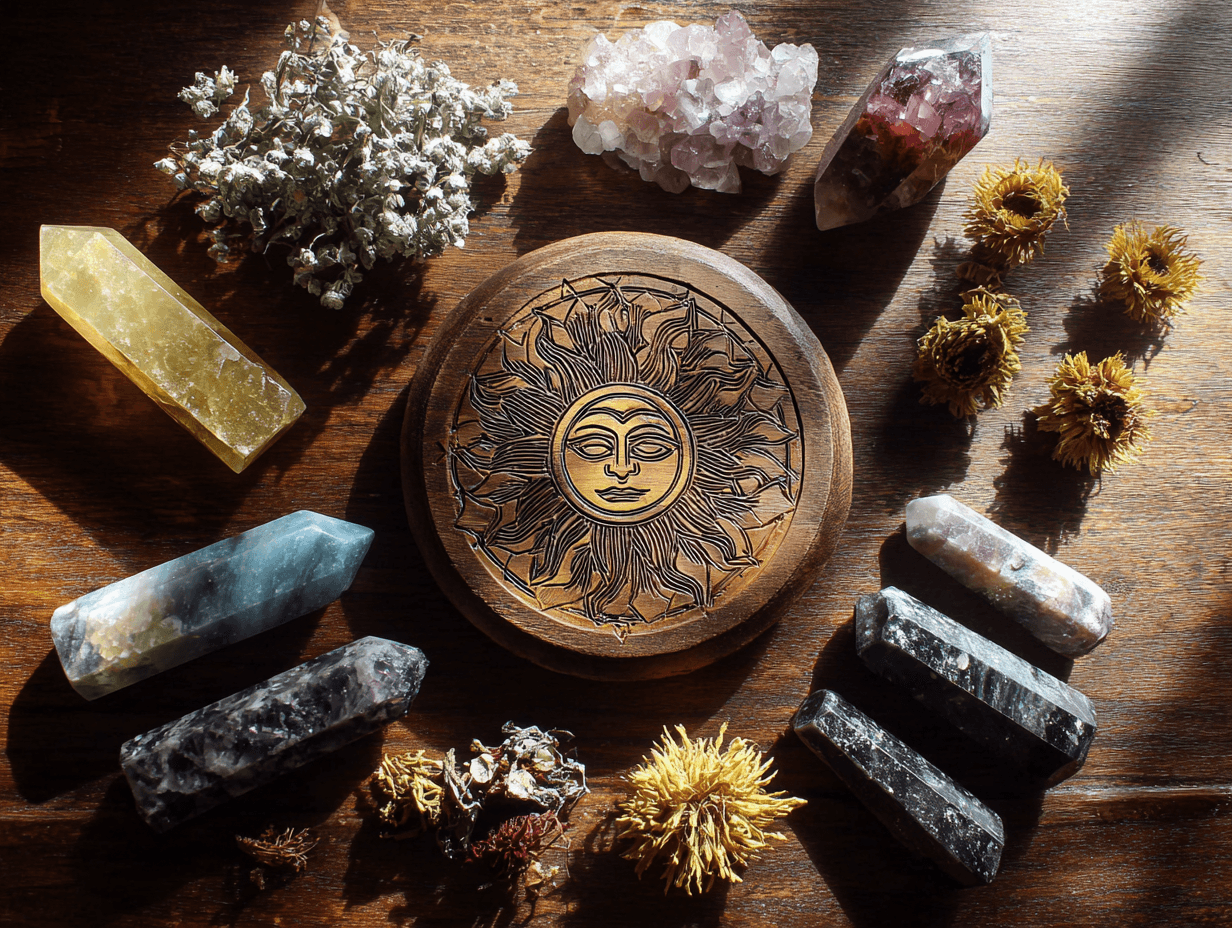
The longest day of the year is eighteen days away. You can feel it already — the way the light lingers past nine, the way the air sits heavy and gold in the late afternoon. Something in you is restless and expansive and a little bit feral. That's not coincidence. That's the sun at its absolute peak, and it's asking you to match its energy.
A Litha altar is how you answer that call. It's not decoration. It's a focal point for the most potent solar energy of the year, a place to anchor your intentions when the wheel is turning at its fullest, brightest moment before the slow tilt back toward dark begins.
Here's how to build one that actually means something.
Why Litha Is the Most Overlooked Sabbat — and Why That's a Mistake
Witches love the dark sabbats. Samhain gets the altars, the aesthetics, the TikTok content. Yule gets the candles and the cozy. Even Beltane has its moment.
Litha gets skipped. Maybe because summer already feels celebratory enough without adding ritual. Maybe because midsummer is so abundant it doesn't feel like it needs anything from us. Maybe because we've forgotten that the most powerful moments in the wheel don't just happen to you — you meet them.
Litha celebrates the longest day of the year, when the Sun is at its strongest — a time of confidence, growth, and celebration that honors light, vitality, and the fullness of life before the slow return toward darkness begins. And here's what that actually means for your practice: this is the sabbat of peak power. Not emerging power like Imbolc. Not potential power like Ostara. Peak. Whatever you've been building since the dark half of the year — your goals, your spells, your work — this is the moment to name it, claim it, and let the sun amplify it.
An altar built for Litha is built for that exact purpose.
The Correspondences: What Belongs on a Litha Altar
You don't need all of this. You need what speaks to you. But knowing the full palette lets you choose with intention rather than guessing.
Colors. Gold, amber, deep yellow, orange, and bright white for the sun at its zenith. Greens for the earth at peak abundance. Blue, green, yellow, pink, and purple also carry Litha's energy — look to nature for the colors of this sabbat, as seen in the sky, woods, and flowers.
Candles. Gold or yellow as the centerpiece, representing the sun's crowning. Add a green one for the earth's fullness. Let them burn during your ritual — fire has been Litha's element since before the sabbat had its modern name.
Crystals. Citrine and sunstone are the obvious choices, and they're obvious for good reason — they hold light in a way that feels almost alive on a summer altar. Add tiger's eye for confidence and amber for ancient solar energy. Gold and yellow items like sun disks, citrine, amber, and tiger's eye all represent the sun's power at this time.
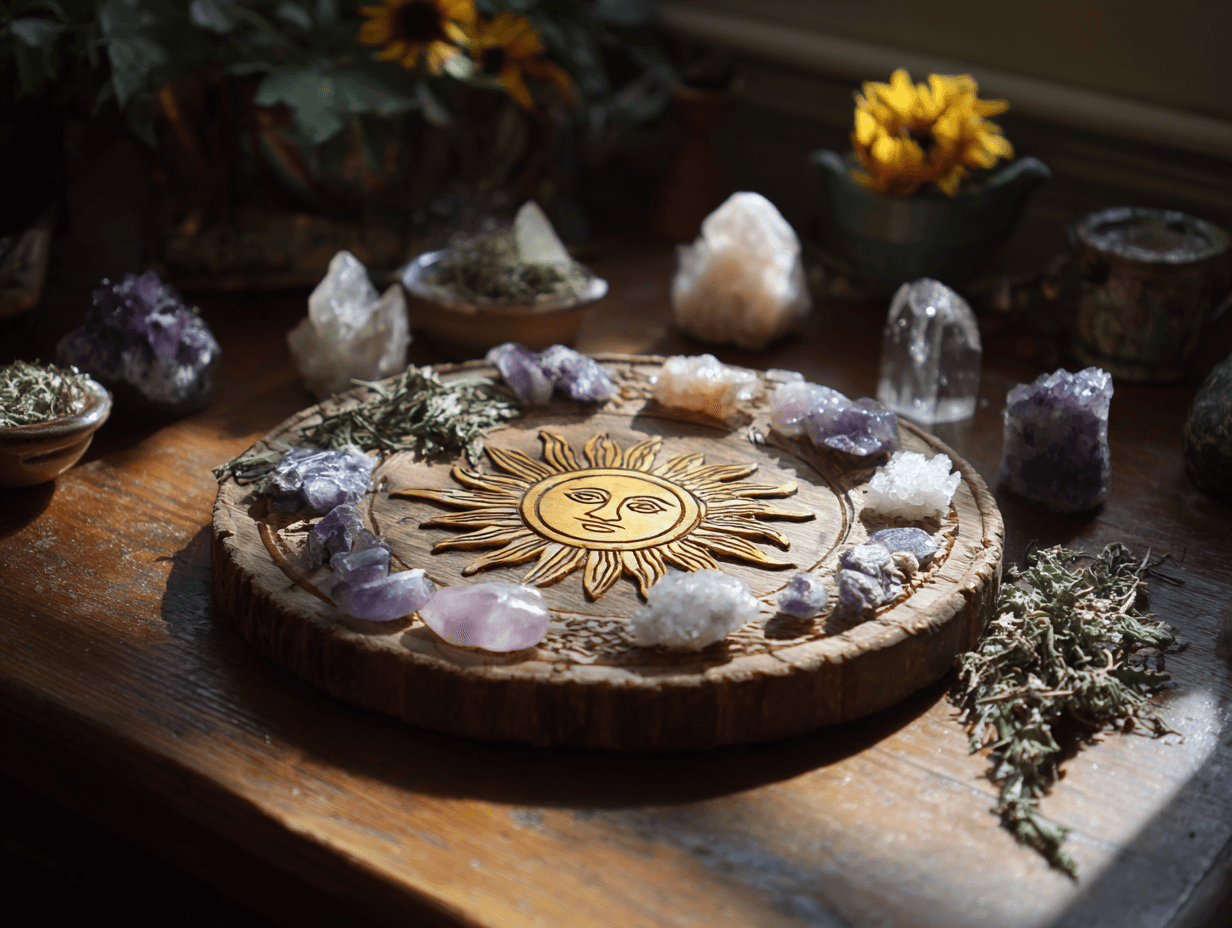
Plants and herbs. This is where a Litha altar really comes alive. Sunflowers are almost comically perfect — all that face-tilting, sun-following devotion in one stem. St. John's Wort is the traditional midsummer herb, historically gathered at the solstice for its protective and healing properties. Add lavender for its peak-season potency, rosemary for the sun's masculine energy, and chamomile for warmth and abundance. Oak leaves and acorns symbolise strength and endurance; freshly harvested lavender, sage, and thyme round out the herbal layer.
Food offerings. Honey, elderberry, strawberry, fennel, thyme, fresh greens, mead, and light wines all belong to this sabbat. A small dish of honey on your altar is both offering and symbol — pure, golden, summoned by sun and flower.
Sun symbols. A brass or gold disk. A circular mirror to catch the light. Anything that carries the shape of the sun. If you own a solar cross or a sunwheel, this is its moment.
How to Build Your Litha Altar: Step by Step
There's no wrong way to build an altar. There's only intentional and unintentional. Start with intention.
1. Choose your location. A windowsill that gets direct morning light is ideal — your altar wakes up with the sun. Outside works too, if you have a sheltered outdoor space. East-facing for sunrise energy. South for peak midday power.
2. Lay your base. A length of golden or green fabric, a flat stone, a wooden board. Something that grounds the altar and marks its edges. This is the container everything else lives inside.
3. Place your central symbol first. This is your sun representation — a candle, a disk, a sunflower in a vase. Build everything else around it. The sun is the center of Litha, which means it's the center of the altar. Literally.
4. Add your crystals and stones. Arrange them intuitively. There's no grid required, though if grid work calls to you, a simple sunburst pattern radiating from the center is appropriate. Let them touch the light when it comes through the window.
5. Bring in the plant world. Fresh flowers in a small vase, dried herbs bundled and tied, a sprig of rosemary laid across the cloth. If you're growing anything in a garden or on a windowsill, a cutting from your own plant is more powerful than anything bought.
6. Add your offering. A small dish of honey. A few strawberries. A cup of sun tea brewed that morning. This isn't performance — it's reciprocity. You're acknowledging that the abundance of this season is given, not earned.
7. Set your intention object. Write one thing you want to call into full power — a goal, a project, a quality in yourself — on a small piece of paper. Fold it toward you. Place it at the base of your central candle. Leave it there through the solstice.
8. Light your candle and close. No elaborate words required unless you want them. "Sun at your peak, I meet you at mine" is enough. Mean it.
Activating Your Altar: The Litha Practice
Building the altar is the container. The practice is what fills it.
The simplest Litha activation: wake early on June 21st and light your altar candle before full sunrise. Sit with it for ten minutes — no phone, no agenda. Watch the light change as the sun comes up. Let the longest day begin from a place of presence.
If you want to go deeper, the traditional Litha practice is fire. Historically, bonfires were lit at midsummer across Europe to match the sun's energy with earthly flame. You don't need a bonfire. A candle is a fire. Light it with intention. Write what you want to release on a piece of paper and burn it safely over a fireproof bowl. Write what you want to call in on another piece and keep it. The sun is at its peak: ask for what you actually want.
Throughout the day, let your altar do its work. Leave the window open. Let direct sunlight hit the crystals. Check in with it in the evening when the gold-hour light falls across it and the longest day begins its one slow exhale.
Adapting Your Litha Altar to Your Practice
If you're a beginner: Start with three items only. A yellow candle, a sunflower or any sun-colored flower, and one written intention. That's a Litha altar. Everything else is elaboration.
If you work with deities: Litha honors solar deities specifically. In Greco-Roman tradition, the Summer Solstice was associated with Apollo, god of the sun, light, and prophecy — a time when the solar oracle was at its most powerful. In Wiccan tradition, Litha marks the God at the height of his power, crowned by the sun. If you work with a sun deity, this is their altar too.
If you work with the full wheel: Your Litha altar should reflect what's come before it. What did you plant at Imbolc? What bloomed at Beltane? This is the solar peak of that arc. Let your altar hold evidence of it — a symbol, a note, something that marks the distance traveled.
If you live somewhere the solstice doesn't feel like summer: The energy still applies. Work with it internally rather than seasonally. The wheel is about the sun's position, not your local weather.
FAQ
What is a Litha altar for?
A Litha altar is a dedicated space for working with the energy of the summer solstice — the longest day of the year and the point of peak solar power in the wheel of the year. It serves as a focal point for intentions around abundance, confidence, visibility, and full-power manifestation. Unlike an everyday altar, it's built specifically for the solstice window and its particular energetic quality.
When should I build my Litha altar?
Anytime in the week leading up to June 21st is appropriate. Building it a few days before gives the altar time to settle and gives you time to sit with it before the solstice itself. Some practitioners build it on the solstice morning, which carries its own immediacy and power. If you're incorporating sun charging, the days immediately around the solstice offer the longest windows of direct light.
Do I need to take my Litha altar down after the solstice?
No timeline is required. Many witches keep sabbat altars up for a few days to a week after the holiday to carry its energy into the season. You can also transition it gradually into a general summer altar by replacing specific solstice items with more everyday elements while keeping the overall warmth and gold of the palette. Take it down when it feels complete.
What crystals are best for a Litha altar?
Citrine, sunstone, amber, tiger's eye, and carnelian are the most aligned crystals for Litha. All carry solar energy in different registers — citrine for abundance and light, sunstone for joy and vitality, amber for ancient warmth and protection, tiger's eye for confidence and action, carnelian for creative and life-force energy. Any crystal that feels warm, bright, or sun-charged belongs here.
Can I build a Litha altar outside?
Absolutely, and if you have the space, it's worth it. A flat stone, a section of garden, a balcony ledge — outdoor altars connect directly to the natural world in a way indoor ones can't fully replicate. Use weather-appropriate materials: natural stones rather than paper, weighted items so the breeze doesn't rearrange things, and a fireproof vessel for any candle work. An outdoor altar that catches the actual midsummer sun is as close to the original practice as modern life gets.
The sun is at its peak. For one day, the light wins completely — and then, quietly, the tilting begins again. A Litha altar doesn't stop that turning. It lets you meet it fully, with your whole self, your clearest intention, and your hands open to the abundance that's already here.
Build it before the solstice. Sit with it on the longest day. Let the sun do the rest.
Working with the full lunar cycle alongside the wheel of the year? The new moon ritual for beginners covers how to weave monthly intentions into your seasonal practice.
For the complete Litha ritual, including spellwork and ceremony, the Wheel of the Year guide gives the full context of how this sabbat fits into the larger cycle.
Comments
Current Moon Phase
Latest Articles

A Cooling Crystal Grid for Hot Summer Nights
Three stones, a simple layout, and five minutes of quiet. A crystal grid for when the heat won't let you sleep and your nervous system needs the reminder that calm is possible.

How to Build a Daily Witchy Practice in 10 Minutes
A real, sustainable daily practice for people with full lives. Ten minutes. Five elements. No altar required, no expensive tools, no perfection.

The Midsummer Fire Spell: A 4-Element Ritual for the Longest Day
A complete Litha ritual using the four elements — earth, water, air, and fire — for morning, noon, late afternoon, and sunset of the summer solstice.

A Sun-Charged Water Spell for the Longest Day
A simple, five-minute practice for the summer solstice. Charge a jar of water in the longest light of the year, then use it all summer long.
3 Herbs to Work With at the Summer Solstice
Three herbs that peak at midsummer, what they're for, and how to use them in the week of the longest day.
Wheel of the Year

Written by
Elyse